Renovating an Old Ghaziabad House
Without Moving Out
A phased plan for older houses and builder floors in Govindpuram, Shastri Nagar, Kavi Nagar, Raj Nagar and nearby, by Shivani Mathur.
You can renovate an older Ghaziabad house or builder floor while living in it if you plan the whole house first and work one zone at a time. Survey and draw the house, then do wet areas and services, then ceilings, walls and floors, then carpentry and fittings, and paint and lights last. Keep one base room and one bathroom working throughout.
- Survey the whole house first: walls, damp, wiring and plumbing
- Do wet areas and services first, one zone at a time
- Keep one base room and one working bathroom at all times
- Made-off-site carpentry cuts dust and time on site
- Check Vastu with the plan, using placement before structural change
DesigningAxis offers interior design and Vastu consultancy. This guide is general guidance and does not assume your house. It is not structural, legal or approvals advice. Any change to walls, columns, beams, the staircase or the plot needs a qualified structural engineer and the local authority's approval where required. Costs and timelines depend on your house and are quoted after a survey.
Why renovate instead of moving
Many families in older parts of Ghaziabad own a house or a builder floor that has been in the family for years. The location works. The children's school is near. The neighbours are known. What does not work is the kitchen, the bathrooms, the storage and the way light reaches the rooms.
Renovating the house you own is often the most practical choice. But living in a house during renovation is hard. Dust, noise, no water for a day and no kitchen for a week. The way to manage it is a good plan.
This guide is written for older independent houses and builder floors in areas such as Govindpuram, Shastri Nagar, Kavi Nagar and Raj Nagar. Local details change, so check yours.
Step 1: Survey and plan the whole house
Do not start with the kitchen. Start with a survey of the whole house, then plan the whole house on paper. Even if you only plan to do one room now, the plan keeps the next room from clashing with it.
- Measure every room, and draw the plan, including doors, windows and any steps
- Mark which walls are structural. If you are unsure, ask an engineer
- Look for damp, cracks, old repairs and seepage lines
- Check wiring: old aluminium wiring, overloaded boards and missing earthing need attention
- Check plumbing and water lines: old pipes, leaks and pressure
- List the rooms by priority and decide what you can live with
Older houses often have rooms added later. We find the real centre of the house from the actual floor plan, not from a neat rectangle. That is also where we read Vastu from.
Step 2: The order of work
The order matters when the family stays at home. We follow this sequence.
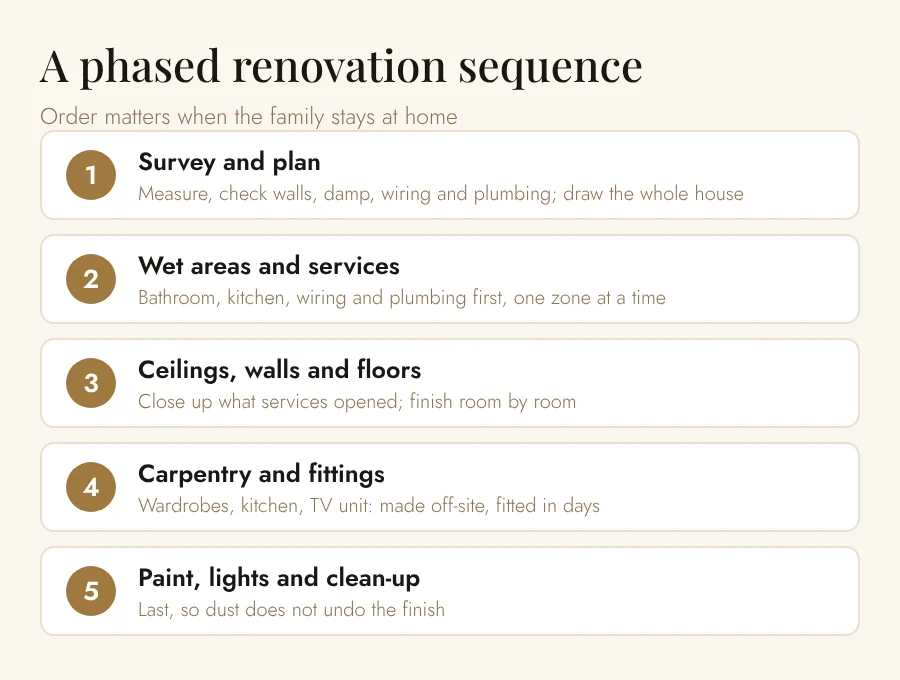
Services first, because opening walls for pipes and wires makes dust and mess. Finish the dirty work before the clean work. Paint and lights come last, so dust does not undo the finish.
Step 3: Work by zone and keep a base room
Divide the house into zones and work one at a time. Keep one base room, one working bathroom and a place to cook or eat at all times.
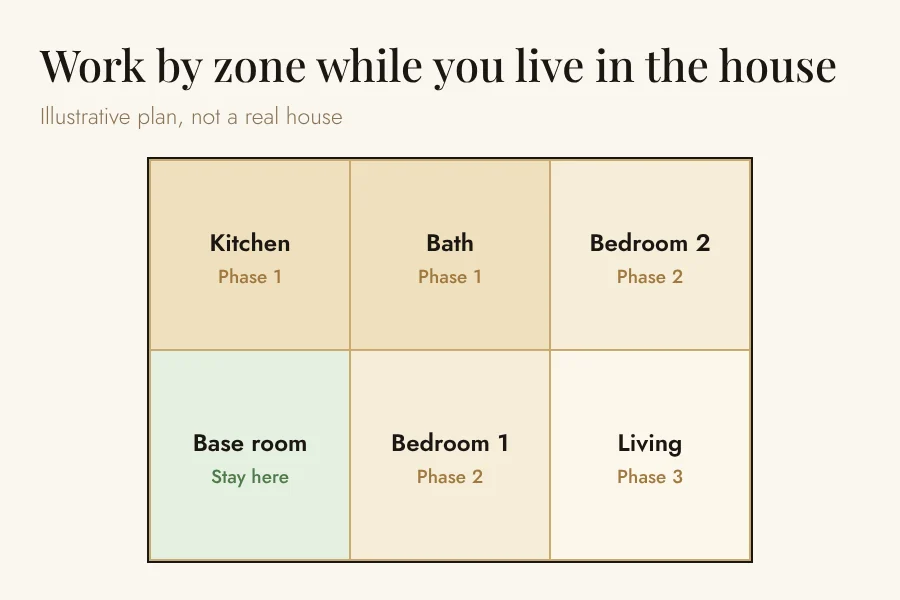
| Phase | Typical work | Where the family stays |
|---|---|---|
| Phase 1 | Kitchen and one bathroom: plumbing, wiring, tiles, platform, units | Base room; cook on a temporary induction setup in another room |
| Phase 2 | Bedrooms and second bathroom: wardrobes, ceilings, flooring, paint | Base room and the finished kitchen |
| Phase 3 | Living and dining: TV unit, ceiling, lighting, furniture | Finished bedrooms and kitchen |
For a builder floor, check the rules of your society or neighbours about noise hours and material movement.
Controlling dust, noise and daily life
- Seal doors between zones with plastic sheets and tape
- Make carpentry off-site, then fit it in a few days instead of cutting on site
- Use dust-free tools where possible and clean daily
- Agree work hours with the family and neighbours
- Cover furniture and store valuables in a closed room
- Plan a temporary kitchen, water storage and a place for cooking
- Keep children and elders away from work zones, with a safe path through the house
The kitchen and bathrooms first
These are the rooms that make the biggest difference in an older house, and they need the most services work. A modular kitchen in an older house needs a layout that fits the real room, good moisture resistance and a proper exhaust. See our Kitchen Design Guide and Materials and Finishes Guide.
Bathrooms start with waterproofing and slope. Finish, tiles and fittings come after. Do not skip the waterproofing test.
Vastu while you renovate
A renovation is the best time to look at Vastu, because things are already moving. Read the house from its centre: find the geometric centre on the plan, hold a compass flat there, align north and mark the four directions. The main door gives only the entrance direction.
Older houses often have a store, a staircase or a kitchen in a spot that does not suit them. We try placement first: move the bed, the storage or the use of a room. Structural change is the last resort. Try our No-Demolition Vastu Checker and read Correcting Vastu Without Demolition.
Keep what you love
Older houses often have good things: a carved door, a wooden staircase rail, a pooja niche, high ceilings, a courtyard. We design around them. A modern kitchen and wardrobes can sit beside a classical living room. The point is not to erase the house, but to make it work.
A renovation should respect the house you have lived in. Keep what carries memory. Change what stops you living well.
— Shivani Mathur, Interior Designer & Vastu ConsultantWhat drives the cost
We do not publish a fixed price, because every house differs. The main drivers are the size of the house, how much civil and services work is needed, the material grade, how much carpentry you want and how many zones you phase. Phasing adds some cost because of repeated set-up, but it keeps the family in the house. Read the Interior Design Cost Guide for the factors in general terms.


Renovation-while-living checklist
Before starting
- Whole house measured and drawn
- Structural walls identified with an engineer's help
- Damp, wiring and plumbing checked
- Rooms listed by priority
Plan
- Zones and phases agreed
- Base room and working bathroom decided
- Temporary kitchen planned
- Vastu read from the centre of the actual plan
During
- Dust sheets and daily clean-up in place
- Carpentry made off-site
- Work hours agreed with family and neighbours
- Paint and lights left for last
Frequently Asked Questions
Can I really live in the house during renovation?
Often yes, if you plan in phases and keep a base room, a working bathroom and a place to cook. We plan the whole house first, then work one zone at a time. The first week of the kitchen is the hardest part.
Which room should I renovate first?
Usually the kitchen and one bathroom, because they need the most services work and make the biggest daily difference. Then bedrooms, then living areas. Paint and lights come last.
Can I remove a wall in an old house?
Only after a qualified structural engineer confirms in writing that it is safe, and with any approval the authority requires. Many older walls are load bearing. We plan around walls as they are.
How do I handle Vastu without breaking walls?
Read the house from its centre, then use placement first: move the bed, desk and heavy storage, adjust colour and light, and make small fixture changes. Structural change is the last resort. Try the No-Demolition Vastu Checker.
How long does a renovation take?
It depends on the size, the amount of civil work and the number of phases. We give a timeline after a survey and do not quote a fixed number before.
How much does it cost?
It depends on the house and the scope. We do not publish a fixed price. Our Interior Design Cost Guide explains the factors, and we quote after a survey.
Do you work in Govindpuram, Shastri Nagar, Kavi Nagar and Raj Nagar?
Yes, we serve these areas of Ghaziabad and the wider Delhi NCR. Send the floor plan or photos on WhatsApp for an online review, or book a site visit.
Planning a Renovation Without Moving Out?
Send your floor plan or photos on WhatsApp. Shivani Mathur tells you what can stay, what should change and in what order, on site across Delhi NCR or online.