Why Vastu Fails in
Modern Indian Apartments
Five planning mistakes we see again and again, and the plain fix for each, by Shivani Mathur.
Vastu usually fails in an apartment for five planning reasons, not because flats are "bad Vastu". People read directions from the door or the balcony, apply plot-house rules to a flat, reach for objects before reading the plan, ignore what the builder has fixed, and forget how the family actually lives. Read the unit from its centre, list what cannot move, and plan only what you control.
- Directions are read from the centre of the unit; the door gives only the entrance direction
- A flat is planned from its own unit plan, not from rules written for a plot house
- Placement, colour and light come before objects and remedies
- The lift core, shafts and wet stacks are fixed: plan around them
- Every zone is checked against storage, light and ventilation
DesigningAxis offers interior design and Vastu consultancy. This guide is general guidance for apartments in India and does not assume your layout. It is not structural, legal or approvals advice. Vastu schools differ on some points, so we say "commonly suggested" where they do. We do not promise results in health, money or relationships.
Why people say "my flat has bad Vastu"
I hear this every week. A buyer or an owner has been told that their flat has a "dosha", usually because the kitchen is in the wrong corner or the main door faces a certain way. They feel stuck, because a builder-fixed flat cannot be rebuilt.
In most cases the flat is not the problem. The reading is. Apartments are tight, repeated floor plans stacked on top of each other, and they need a method that fits them. When the method is wrong, the answer is wrong, and then the remedies pile up and do not help.
Below are the five mistakes I see most. Each has a plain fix you can start on today.
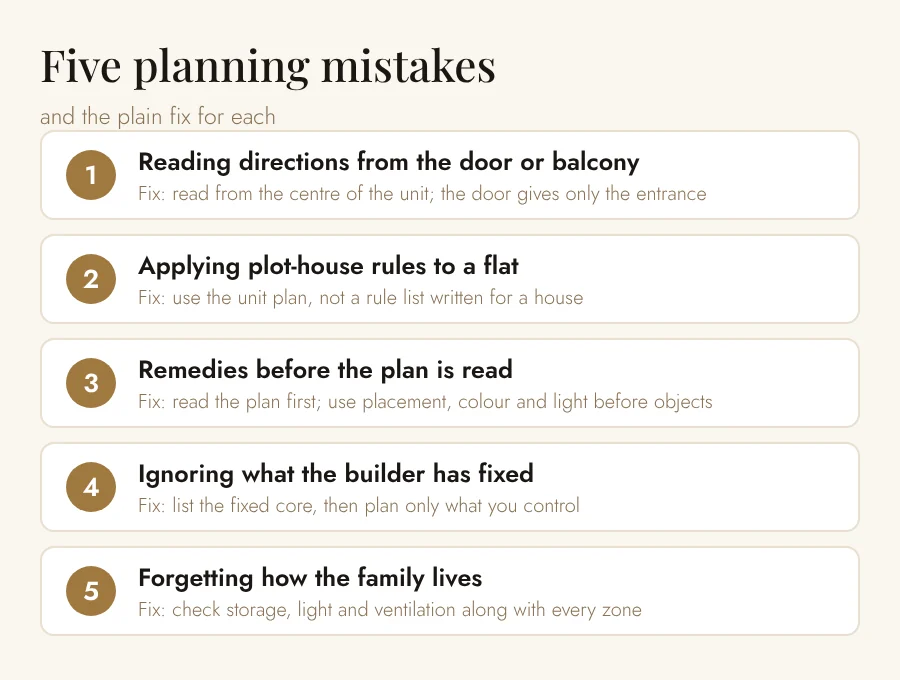
Mistake 1: Reading directions from the door or the balcony
This is the most common one. Someone stands in the doorway, looks out and says "this is an east-facing flat". Or they use the balcony, or the direction the tower faces.
The door gives you one thing: the entrance direction. The directions of the home, which decide where the kitchen, bedrooms and pooja fall, are read from the centre of the home. Find the geometric centre of the unit on the floor plan, hold a compass flat there, align north and mark north, south, east and west.
For an irregular or L-shaped flat, use the actual plan and find the centre carefully. Do not use a rectangle drawn around the flat.
- Is north marked on your floor plan?
- Did you find the centre of the unit, not the centre of the living room?
- Was the compass held flat, away from steel and phones?
- Did you cross-check once with the sunrise side or a map app?
Our guide Vastu for Flats and Apartments covers the full zone-by-zone method.
Mistake 2: Applying plot-house rules to a flat
Many Vastu articles are written for a plot house. They talk about the compound wall, the gate, the open yard, the septic tank and the slope of the land. A flat has none of these. Its walls, floor and ceiling are shared, its entrance is a corridor door, and its plan is a cut of a larger floor.
So when someone applies "the house should be higher in the south-west" or "keep the north open" to a flat, the advice does not fit. In a flat you work with the unit plan: the position of rooms, doors, windows, wet areas and storage, and the light each room gets.
| What a plot rule says | What it means in a flat |
|---|---|
| Slope of land | Not applicable. Look at floor level only if the plan has a step. |
| Compound wall and gate | Not applicable. The unit door is your entrance. |
| Open yard to the north or east | Use balconies and windows on that side for light and air. |
| Septic tank location | Not applicable. The wet stack is fixed by the building. |
If you want the plot version, read Vastu for House, Land and Flat Shapes. Keep the two separate in your head.
Mistake 3: Reaching for remedies before reading the plan
When a buyer is told "your kitchen is in the wrong zone", the next sentence is often "buy this pyramid" or "keep this crystal there". The object is sold before the plan is read.
I am careful here. Some people find objects comforting, and I will not argue with that. But an object cannot replace a better plan. If a bed is in a poor spot, the first thing to try is to move the bed. If the kitchen platform faces a difficult way, we look at how you stand and work first.
My order is simple. First placement: move furniture and storage. Then colour and light. Then small fixture changes. Objects, if you want them, come last and are never the main fix. See our No-Demolition Vastu Checker for a quick idea of what can be solved without breaking anything.
Mistake 4: Ignoring what the builder has fixed
In an apartment, a lot is fixed before you arrive. The lift and staircase core, the plumbing shafts, the stacked bathrooms and often the kitchen position are set by the building. You cannot move them, and neither can a consultant.
The useful question is not "which zone is wrong?". It is "which parts can I actually change?". Make two lists. List one is the fixed core. List two is what you control: furniture, storage, the bed, the desk, the wardrobe, colours, lights, curtains, the entrance area and the use of each room.
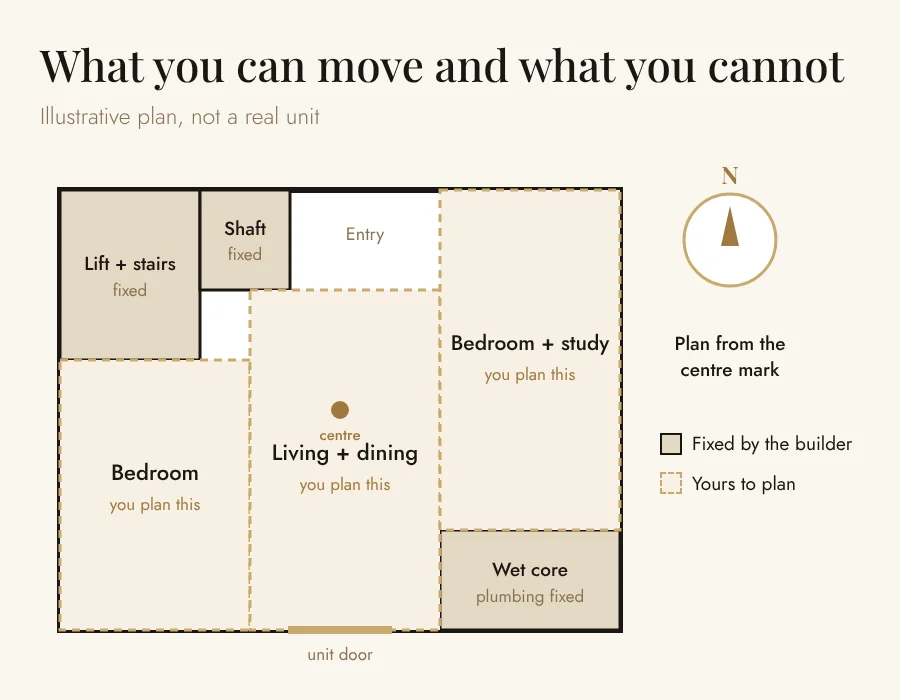
Once you separate them, the problem often gets smaller. A fixed toilet in a corner is a fact. What you put next to it, how you ventilate it and how you light the room beside it are choices.
Mistake 5: Forgetting how the family lives
A plan that follows every rule but has no storage, no daylight in the study or a bed that blocks the balcony door is a bad plan. It will be changed within a year, and the changes will undo the Vastu anyway.
Every zone needs a quick reality check. Where does the family cook, sleep, study and keep shoes? Where does the washing dry? Does the elderly parent have a room near a bathroom? In a flat of 1,000 to 1,500 square feet there is little slack, so the check is not optional.
- Storage: does each bedroom have enough wardrobe space, and where is the overflow?
- Light: do the rooms you use most get daylight when you use them?
- Air: can a window or exhaust clear cooking smoke and bathroom damp?
- Movement: can two people pass in the kitchen and corridor?
This is why we plan Vastu and interior design together. Read the Complete Vastu Guide for Your New Home and the 2BHK Interior Planning Guide side by side.
A better method, in five steps
- Get the unit plan. Ask for the approved plan of your exact unit, with north marked.
- Mark the fixed core. Lift, stairs, shafts, wet stacks and structural walls.
- Find the centre. Hold the compass flat there, align north, and mark the four directions.
- Place rooms and heavy items by zone, as far as the plan allows.
- Check daily use. Storage, light, air and movement, then decide.
A flat does not need to be rebuilt. It needs to be read properly. Find the centre, mark what cannot move, and plan the rest.
— Shivani Mathur, Interior Designer & Vastu ConsultantWhen a flat really is a poor fit
Sometimes a unit is difficult. A wet core sits in the middle of the plan. The only entrance leaves no room for an entry area. Several rooms have no daylight. If you have not bought yet, this is a good reason to compare another unit or floor. Use the Pre-Purchase Vastu Checklist before you pay.
If you have already bought, do not panic. Many concerns can be reduced without any demolition. Read our guide on correcting Vastu without breaking walls, and bring your plan for a review.


Apartment Vastu planning checklist
Reading
- Approved unit plan in hand, north marked
- Centre of the unit found on the plan
- Compass held flat, away from metal
- Entrance direction read separately at the door
Plan
- Fixed core shaded: lift, stairs, shafts, wet stacks
- Rooms placed against the nine zones
- Heavy storage kept out of the centre
- Bed, desk and kitchen use checked
Daily use
- Storage per bedroom counted
- Daylight and air per room checked
- Remedies, if any, listed after placement fixes
- Questions for the consultant written down
Frequently Asked Questions
Is it true that an apartment cannot have good Vastu?
No. Every apartment can be planned well. Some units are easier than others, because the fixed core and the room positions differ. What matters is reading the unit properly, controlling what you can and not blaming the flat for what is a method problem.
How do I find the directions of my flat?
Use the floor plan to find the geometric centre of your unit, hold a compass flat there, align north and mark north, south, east and west. The main door gives only the entrance direction. For an L-shaped or irregular flat, use the actual plan and find the centre carefully.
My kitchen is in the north-east. Is the flat ruined?
No. Different schools treat this differently, and the answer depends on the whole plan. Start with what can change: ventilation, light, the use of the room and what is stored next to it. We review the plan before suggesting anything.
Do pyramids and crystals work?
We do not rely on objects. Some people like them and we do not object, but they cannot replace a better layout. Fix placement, colour and light first. Use objects, if at all, as a final touch.
Can Vastu be fixed without demolition in a flat?
Often yes. Many concerns can be reduced by moving furniture and storage, changing colour and lighting, and making small fixture changes. Some defects need a bigger change, and we say so honestly.
Should I check Vastu before buying a flat?
Yes, it is the best time. A different unit or floor often has a better plan. Use our Pre-Purchase Vastu Checklist, and send the unit plan for a review before you pay the next instalment.
Do you review plans online?
Yes. Send the floor plan with north marked and photos of the entrance on WhatsApp. We also visit sites across Ghaziabad, Delhi and the wider NCR.
Want Your Flat Plan Read Properly?
Send your unit plan with north marked. Shivani Mathur reviews it for Vastu and interior planning, on site across Delhi NCR or online anywhere in India.