Modular Kitchen Design Guide
for Indian Homes
Layouts, modular vs civil, materials, storage solutions and a complete budget guide — everything you need to design the perfect modular kitchen, by Shivani Mathur.
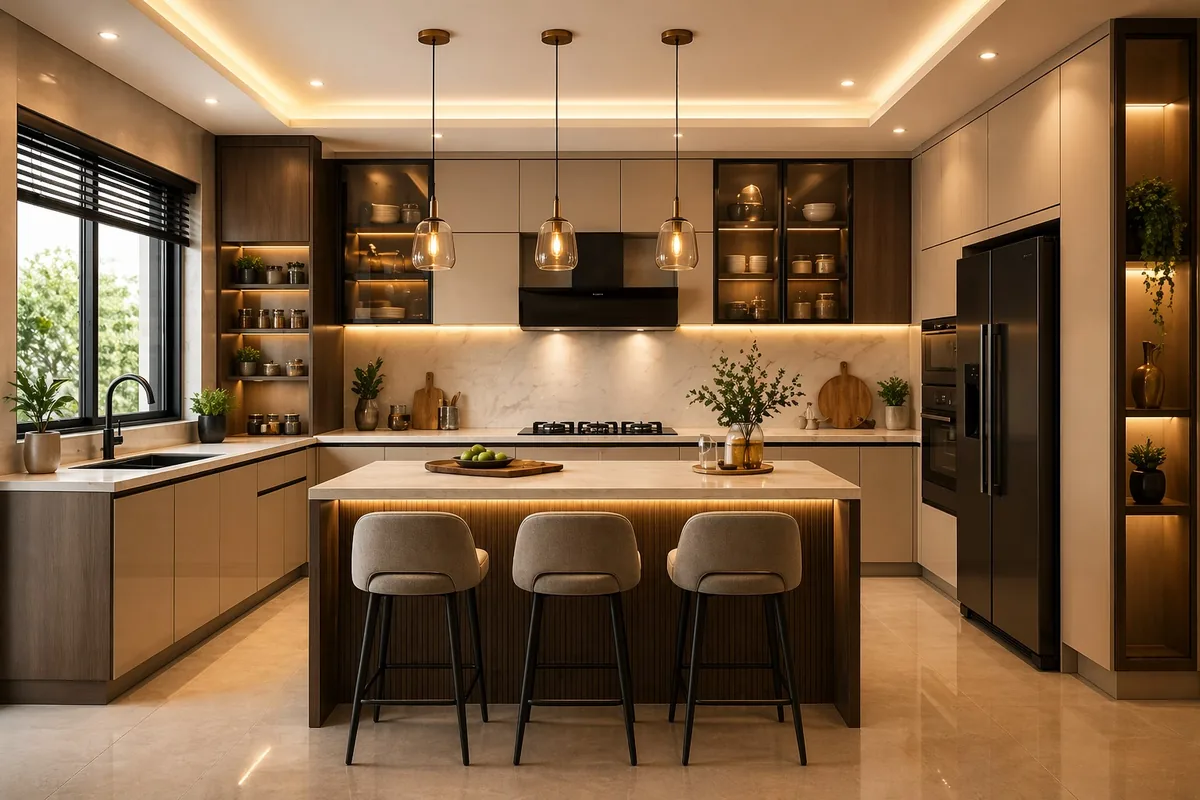
Premium island kitchen design by DesigningAxis by Shivani.
The kitchen is the most technically complex room in any home — and in Vastu, it is also the most energetically sensitive. It governs the fire element, which in turn governs health, nourishment, and the vitality of the entire family. Getting your modular kitchen right requires balancing layout efficiency, material quality, Vastu alignment, and budget — all at once. This guide covers everything.
Kitchen Layouts — Which Is Right for Your Space?
The layout of your modular kitchen determines how efficiently you work, how comfortable the space feels, and how well it can accommodate Vastu requirements. Here are the four primary layouts for Indian homes.
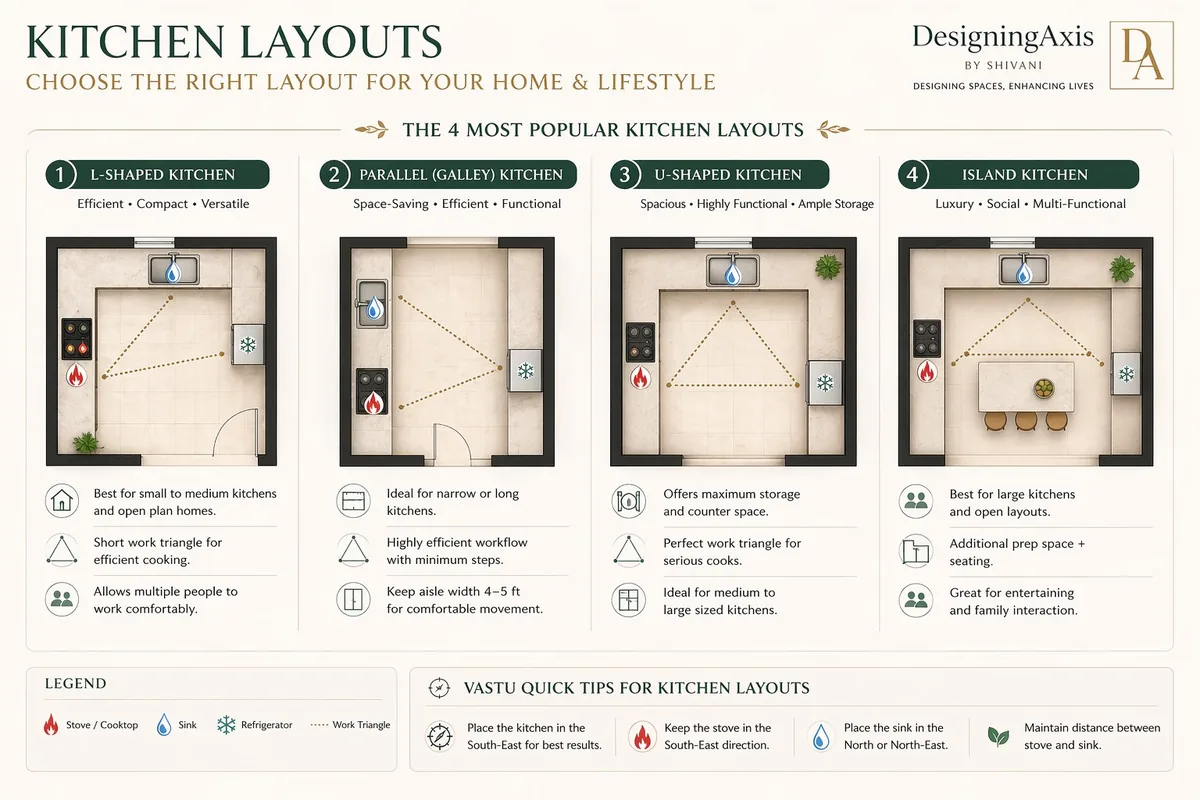
The 4 most popular kitchen layouts with Vastu quick tips — by DesigningAxis by Shivani.
L-Shaped
Most versatile for Indian kitchens 60–120 sq ft. Two walls used, corner storage maximised. Excellent for achieving correct stove-sink separation. Best for South-East and North-West kitchens.
Parallel (Galley)
Two parallel walls — extremely efficient for long, narrow kitchens. Allows the cook to face East naturally. Most common layout in Indian apartments.
U-Shaped
Maximum storage and counter space. Best for larger kitchens 120+ sq ft. Three walls used — requires careful Vastu planning to keep stove and sink separated.
Island Kitchen
Open-plan, premium. Island used for prep or dining. Requires 180+ sq ft. Vastu requires island not to carry the stove — keep stove on the SE wall platform.
Modular vs Civil Kitchen — Which Should You Choose?
| Factor | Modular Kitchen | Civil / Masonry Kitchen |
|---|---|---|
| Construction | Factory-made cabinets, site-assembled | Built on-site with bricks/RCC |
| Time to Complete | 3–7 days installation | 3–6 weeks construction |
| Finish Quality | Precise, consistent, premium | Depends entirely on mason skill |
| Vastu Flexibility | Easy to reconfigure stove/sink positions | Permanent — corrections require demolition |
| Storage Efficiency | Pull-outs, tandem boxes, corner units | Basic shelves — less efficient |
| Cost (60 sq ft) | ₹1.8L–₹5L+ | ₹80,000–₹1.8L |
| Longevity | 15–20 years with maintenance | Prone to seepage, cracking over time |
| Resale Value | Significantly increases property value | Neutral or negative |
For any new home or renovation, modular is almost always the better investment. The precision finish, Vastu flexibility, superior storage, and resale value make the higher upfront cost worthwhile. Civil kitchens are only advisable when structural constraints make modular impossible.
Materials & Finishes — What to Choose
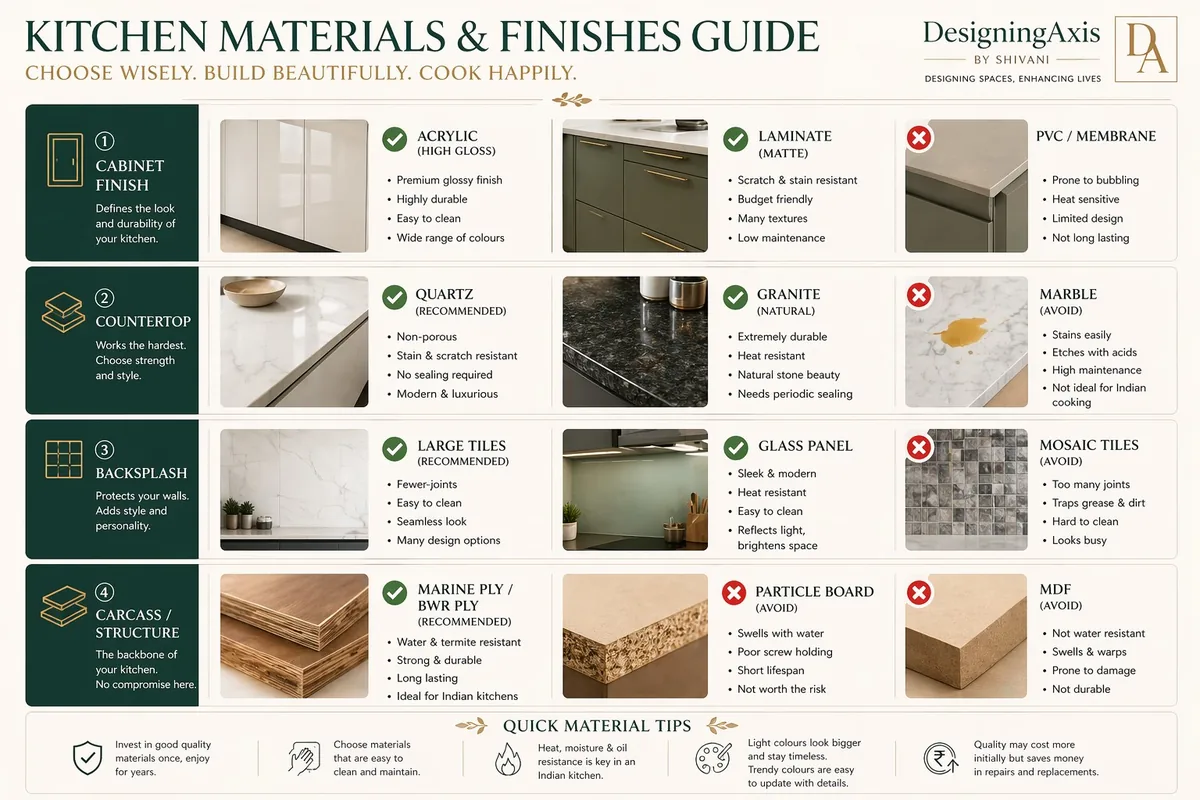
Complete kitchen materials and finishes guide — what to choose and what to avoid, by DesigningAxis by Shivani.
Cabinet Shutters — Acrylic or Laminate
Acrylic gives a high-gloss mirror finish — premium look, easy to clean, very durable. Matte laminate offers a softer, more contemporary finish. Both are superior to PU paint for Indian kitchens. Avoid painted MDF — it chips and discolours rapidly near heat and steam.
Countertop — Quartz or Granite
Quartz (engineered stone) is harder, non-porous, and more stain-resistant than natural granite — the best countertop choice for Indian kitchens. Granite is beautiful but porous and requires sealing. Avoid marble for the kitchen — it stains irreversibly with turmeric and acidic foods.
Backsplash — Tiles or Glass
Large-format tiles (600×300 or larger) give a premium, easy-to-clean backsplash. Fluted glass panels are a contemporary premium option. Avoid small mosaic tiles — the grout lines trap grease and are very difficult to maintain in an Indian kitchen.
Cabinet Carcass — Marine Ply or BWR
The cabinet carcass (internal structure) should be 18mm BWR (Boiling Water Resistant) or marine-grade plywood. Avoid particle board or MDF for carcasses — they swell with moisture and fail within 5–8 years in Indian humidity conditions.
Hardware — Hettich or Hafele
Always specify branded hardware (Hettich, Hafele, or Blum) for hinges and drawer channels. Unbranded hardware is the single most common reason modular kitchens fail prematurely. The cost difference is ₹8,000–₹15,000 for an entire kitchen — a worthwhile investment.
✦ Looking for Kitchen Vastu?
This guide focuses on design, materials and layout. For the complete Vastu guide covering cooking direction, stove-sink placement, kitchen zone and Vastu colours — see our dedicated Kitchen Vastu Guide →
Not Sure Which Layout Suits Your Kitchen?
Get a Kitchen Vastu & Design Consultation
Shivani visits your home, assesses the kitchen zone, cooking direction, and platform layout — and designs a modular kitchen that is both beautiful and perfectly Vastu-aligned.
Maximising Storage — The 6 Rules
✓ DO: Storage Best Practices
- Floor-to-ceiling upper cabinets — use every inch of vertical space
- Tall pantry unit — stores more than 3 standard upper cabinets combined
- Pull-out drawers instead of lower shelves — 3x more accessible
- Corner carousel or magic corner unit — eliminates dead corner space
- Integrated appliance housing — microwave, oven in tall unit
- Under-sink pull-outs — maximises often-wasted space
✗ AVOID: Common Mistakes
- Leaving gap above upper cabinets — dead space that collects dust
- Open lower shelves — impractical for Indian cooking
- No pantry unit — forces piling items on countertops
- Glass shutters on all cabinets — beautiful but requires everything to be tidy always
- Handles that catch on clothing — choose inset or bar handles
- White grout in backsplash — turns yellow within months near cooking
Kitchen Budget Guide — NCR 2026
| Kitchen Size | Mid-Range Modular | Premium Modular | Key Difference |
|---|---|---|---|
| Small (up to 60 sq ft) | ₹1.8L–₹2.8L | ₹3L–₹5L | Acrylic vs laminate shutters |
| Medium (60–100 sq ft) | ₹2.5L–₹4L | ₹4.5L–₹7L | Quartz countertop, SS sink |
| Large (100+ sq ft) | ₹3.5L–₹5.5L | ₹6L–₹12L | Island, tall units, appliances |
*Indicative ranges for Ghaziabad/Noida/Delhi NCR as of 2026. Excludes chimney, hob, and built-in appliances. Add ₹35,000–₹80,000 for quality chimney and hob.
Frequently Asked Questions
Which direction should the kitchen be in according to Vastu?
The South-East direction is ideal for the kitchen in Vastu as it is governed by Agni, the fire element. North-West is the second-best option. Avoid placing the kitchen in the North-East — this creates a serious Vastu dosha as it puts fire energy in the sacred, water-associated NE zone.
Modular kitchen vs civil kitchen — which is better for Indian homes?
Modular kitchens are almost always the better choice for Indian homes. They offer superior finish quality, significantly better storage efficiency with pull-outs and corner solutions, Vastu flexibility to adjust stove and sink positions, and much faster installation. The higher upfront cost is offset by durability and resale value.
What is the best countertop material for an Indian kitchen?
Quartz (engineered stone) is the best countertop material for Indian kitchens. It is harder than granite, completely non-porous so it resists turmeric and oil stains, requires no sealing, and is available in a wide range of colours. Avoid marble — it stains irreversibly with Indian cooking ingredients.
Can the stove and sink be on the same wall?
Yes, but they must never be directly adjacent without separation. In Vastu, fire (stove) and water (sink) in direct contact create an elemental clash associated with health issues and family conflict. Always separate them with at least one cabinet. The ideal placement is stove on the East or SE wall, and sink in the North or NE of the kitchen.
What colours should I avoid for a modular kitchen?
Avoid dark navy, royal blue, black, and dark charcoal as dominant kitchen colours. These are water colours that conflict with the kitchen's fire energy. Contemporary dark modular kitchens look beautiful in showrooms but create Vastu imbalance in the home. If you love dark kitchens, use them on upper cabinets only with warm-toned lower cabinets and countertop.
✦ Looking for Kitchen Vastu?
This guide focuses on design, materials and layout. For the complete Vastu guide covering cooking direction, stove-sink placement, kitchen zone and Vastu colours — see our dedicated Kitchen Vastu Guide →
Ready to Apply This?
Get a Personalised Consultation with Shivani Mathur
Every home is unique. Shivani will assess your specific space and give you a tailored plan combining everything in this guide with your actual floor plan, family needs and budget.
Need Professional Help?
Apply these principles with expert guidance. Shivani Mathur offers personalised interior design and Vastu consultations across Delhi NCR — modular kitchen designer in Ghaziabad or kitchen interior designer in Noida.