How to Choose the Right Wardrobe
for Your Bedroom
Sliding vs hinged, materials, internal layout, finishes and Vastu placement — the complete wardrobe design guide by Shivani Mathur.
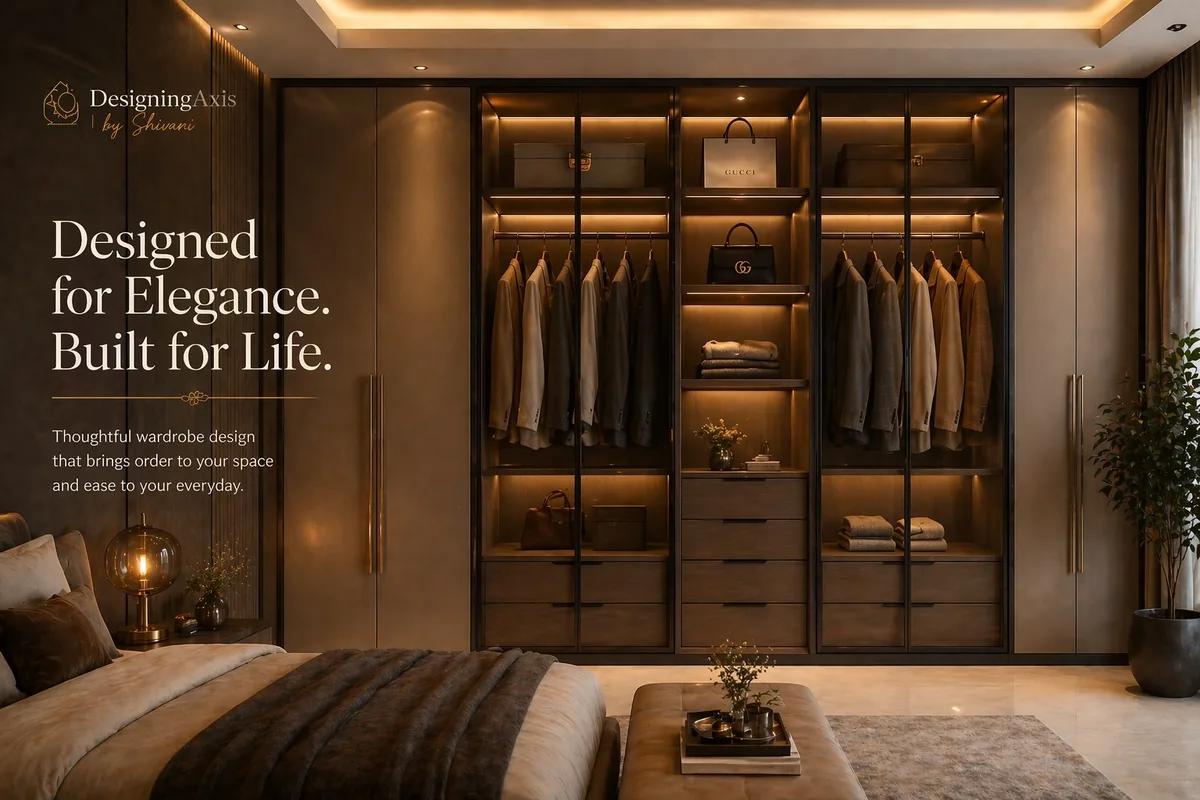
Designed for Elegance. Built for Life. — Premium wardrobe with warm LED interior lighting, by DesigningAxis by Shivani.
The wardrobe is the workhorse of the bedroom — the element that, when designed well, organises your life and when designed poorly, creates daily frustration for years. A well-designed wardrobe is not just about storage volume — it is about how efficiently you can access what you need, how it looks within the bedroom aesthetic, and — in Vastu — where it is placed and how it affects the room's energy. This guide covers everything.
Wardrobe Types — Sliding vs Hinged
The first decision in any wardrobe design is the door mechanism. This affects aesthetics, space efficiency, accessibility, and budget significantly.
| Type | Best For | Pros | Cons | Budget Range |
|---|---|---|---|---|
| Sliding Doors | Rooms under 150 sq ft | Space-saving, sleek, contemporary look | Access only half at a time, track needs cleaning | ₹25,000–₹70,000 |
| Hinged Doors | Any room size | Full access at once, classic, more storage options | Requires swing space in front | ₹30,000–₹80,000 |
| Glass Front | Display-worthy interiors | Premium look, shows off contents, with warm LED | Everything must always be tidy | ₹40,000–₹1L |
| Open Shelf (Partial) | Boutique / dressing room style | Display space, easy access to daily items | Collects dust, requires disciplined organisation | ₹20,000–₹55,000 |
| Walk-in Wardrobe | Large master bedrooms 250+ sq ft | Full dressing room experience, maximum storage | Requires significant space dedication | ₹1L–₹3L+ |
Wardrobe Materials — What Lasts
✓ Recommended Materials
- 18mm BWR / Marine Ply carcass — moisture-resistant, strong, long-lasting 15–20 years
- Acrylic shutter finish — premium gloss, easy to clean, wide colour range
- Matte laminate shutters — contemporary, scratch-resistant, excellent value
- Hettich / Hafele hardware — branded channels and hinges last 10+ years
- Soft-close mechanisms — non-negotiable for premium feel, protects doors long-term
- Mirror on one door — functional and optically expands the bedroom
✗ Avoid These
- Particle board or MDF carcass — swells with humidity, fails in 5–8 years in Indian conditions
- PU paint finish — chips near edges and hinges within 2–3 years of daily use
- Unbranded channels — most common cause of wardrobe failure within 3–4 years
- Very dark interiors — black or very dark carcass interiors make finding items difficult
- No internal lighting — walk-in wardrobes especially need LED strips inside
Internal Layout — Where Every Inch Counts
The interior organisation of a wardrobe determines how efficiently it functions daily. A poorly planned interior wastes 30–40% of available storage.
Long Hang Section
Minimum one section for full-length garments — sarees, salwar suits, dresses, formal trousers. Minimum height 52 inches. Position in the centre or one end of the wardrobe. One long hang section is sufficient for most wardrobes unless exclusively used for formal wear.
Short Hang Section
For shirts, kurtas, jackets, and folded trousers. Minimum height 32–36 inches. Allows a drawer unit below — doubling the storage in this section. Two or three short hang sections are standard for most Indian master bedrooms.
Shelf Sections
Adjustable shelves for folded items — sweaters, t-shirts, jeans, linens. Adjustable shelving is a must — fixed shelves become the wrong height within months. Include one deep shelf at the bottom for bags and shoes.
Drawer Unit
2–3 drawers integrated into the wardrobe for small items — undergarments, accessories, jewellery. Soft-close drawers with internal organisers are the mark of a premium wardrobe. Tandem box drawers (full extension) are significantly more functional than standard drawers.
Top Section
The space above the short hang sections — often wasted. Use it for a lift-up door or pull-down rail for seasonal items, guest bedding, or rarely-used pieces. Don't leave this space empty — it is valuable cubic storage.
"The wardrobe should always be placed in the South or West wall of the bedroom — the stability zone. The North-East corner must be kept free of heavy storage — this is the sacred zone that should remain light and open. Mirrors on wardrobe doors are excellent as long as they don't directly face the bed when the door is open."
— Shivani Mathur, Vastu ConsultantFinish Options & Aesthetics
High Gloss Acrylic
Reflective, premium, contemporary. Creates visual lightness. Best in neutral tones — cream, white, champagne. Fingerprint-prone but very easy to wipe clean.
Matte Laminate
Sophisticated, anti-fingerprint, versatile. Available in hundreds of tones and textures. The most popular choice for mid-to-premium bedrooms in 2024–25.
Wood Veneer
Warm, natural, luxurious. Real wood grain appearance. Premium segment. Pairs beautifully with gold hardware and a neutral bedroom palette.
Glass + Metal Frame
Boutique hotel aesthetic. Show-stopping when contents are well organised. Add warm LED strips inside for a retail display effect.
Wardrobe Budget Guide — NCR 2026
| Wardrobe Size | Type | Mid-Range | Premium |
|---|---|---|---|
| 6 ft wide, 2-door | Sliding, laminate | ₹28,000–₹42,000 | ₹48,000–₹75,000 |
| 8 ft wide, 3-door | Sliding, acrylic/veneer | ₹40,000–₹65,000 | ₹70,000–₹1.1L |
| 10 ft wide, 4-door | Hinged or sliding | ₹55,000–₹85,000 | ₹90,000–₹1.5L |
| Wall-to-wall (12+ ft) | Full wall, any door type | ₹70,000–₹1.1L | ₹1.2L–₹2.2L |
| Walk-in Wardrobe | Open shelving + island | ₹1.2L–₹2L | ₹2.5L–₹5L |
*Indicative ranges inclusive of materials and installation. Ghaziabad/NCR rates as of April 2026.
The most impactful wardrobe investment in order: (1) BWR ply carcass — don't compromise here; (2) branded soft-close hardware — Hettich or Hafele only; (3) internal organisation with drawers and tandem boxes. Get these three right and the wardrobe will function beautifully for 15+ years regardless of the door finish chosen.
Frequently Asked Questions
Sliding vs hinged wardrobe — which is better for an Indian bedroom?
Sliding wardrobes are better for rooms under 150 sq ft as they don't require swing space. Hinged wardrobes give full access to all sections simultaneously and tend to offer more storage flexibility. For most Indian bedrooms between 150–200 sq ft, both work well. The decision comes down to aesthetic preference and how you use the wardrobe — if you frequently need to see everything at once, choose hinged.
What is the best material for a wardrobe carcass (internal structure)?
18mm BWR (Boiling Water Resistant) or marine-grade plywood is the best carcass material for Indian conditions. It resists moisture, holds screws firmly, and lasts 15–20 years. Avoid particle board and MDF for the carcass — they swell with humidity and fail within 5–8 years. This is the most important material decision in wardrobe construction.
Where should the wardrobe be placed in the bedroom according to Vastu?
The wardrobe should be placed on the South or West wall of the bedroom according to Vastu Shastra. These are the stability zones. Avoid placing the wardrobe in the North-East corner — this is the sacred zone that should be kept light and free of heavy furniture. If a mirror is on the wardrobe door, ensure it does not face the bed directly when open.
How tall should a wardrobe be?
Floor-to-ceiling wardrobes are the most efficient as they use all available vertical space without leaving a gap above that collects dust. For standard 9–10 foot ceilings, a floor-to-ceiling wardrobe with a top section (accessible via step stool) gives the most storage. The top section is ideal for seasonal items, guest bedding, and rarely used items.
What is the standard wardrobe depth?
Standard wardrobe depth for hanging clothes is 22–24 inches (55–60 cm). Anything less and clothes will protrude past the door edges. Walk-in wardrobe island units are typically 18–20 inches deep. Shelf-only sections can be shallower at 16–18 inches if needed for space-saving.
Ready to Apply This?
Get a Personalised Consultation with Shivani Mathur
Every home is different. Shivani will assess your specific space and give you a practical, tailored plan.
Need Professional Help?
Apply these principles with expert guidance. Shivani Mathur offers personalised interior design and Vastu consultations across Delhi NCR — interior designer in Indirapuram or interior designer in Greater Noida.